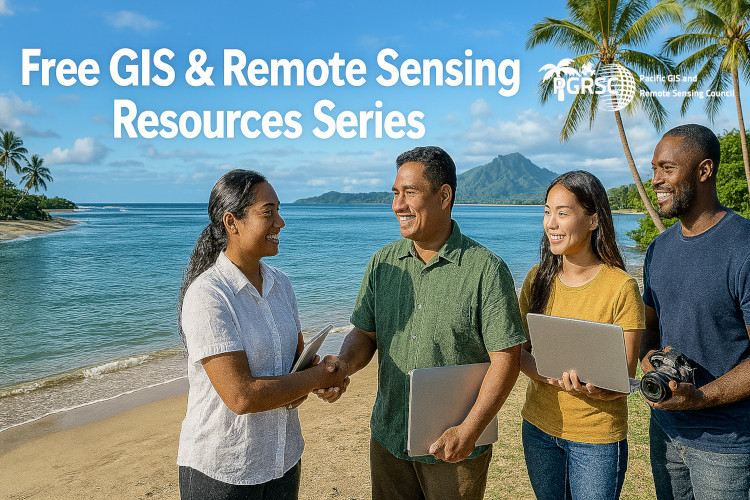
On behalf of the Pacific GIS and Remote Sensing Council (PGRSC), we apologize for the pause in our series to promote free GIS and remote sensing resources (webinars, instructional videos, technical manuals, e-books, etc.) to increase capacity, awareness, and skill development for the Pacific Islands geospatial community. During November and December, we were quite busy preparing for 2025 Pacific Islands GIS and Remote Sensing User Conference in Fiji and the following holidays. To make up for the delay, we are posting resources for all of the weeks that we were paused.
Please see below for Weeks 13 to 20:
Week 13: UN Handbook on Remote Sensing for Agricultural Statistics
The United Nations Food and Agriculture Organization recently released the 2025 UN Handbook on Remote Sensing for Agricultural Statistics, a free online practical guide to the application of remote sensing for agricultural statistics, equipping readers with the methodologies required to generate high-quality land use maps and crop yield predictions. Each chapter includes executable R and Python scripts that the user can use for analysis and decision making.
https://fao-eostat.github.io/UN-Handbook
Week 14: Fundamentals of Remote Sensing Online Book
The Junior Academy of Sciences of Ukraine, National Center, published a free online Fundamentals of Remote Sensing practical book which discusses satellites orbiting the Earth and how remote sensing data can be used to assess emergencies, monitor water bodies, agricultural land, and volcanic activity in the Sentinel Earth Observation Browser, and more.
Week 15: Sentinel Hub Collection of Custom Scripts
Sentinel Hub hosts a repository which contains a collection of custom scripts which can be fed to the services via the URL to collect and analyse various satellite imagery for a variety of use cases.
https://custom-scripts.sentinel-hub.com
Week 16: Visualizing Land Cover and Land Use Change with NASA Satellite Imagery Workshop (February 24-26, 2026)
NASA’s Applied Remote Sensing Training Program (ARSET) will provide a free online training course on how to use the R statistical coding language to classify land cover and quantify changes in land cover over time.
Session A: Feb. 24-26, 2026,11:00 a.m. – 1:00 p.m. EST(1600-1800 UTC)
Session B: Feb. 24-26, 2026,2:00-4:00 p.m. EST(1900-2100 UTC)
Course registration is currently open at:
https://www.earthdata.nasa.gov/learn/trainings/visualizing-land-cover-land-use-change-nasa-satellite-imagery
Week 17: Global Forest Watch
Global Forest Watch, or GFW, is an initiative from the World Resources Institute (WRI) committed to providing the best publicly available data and tools for monitoring and protecting the world’s forests. By harnessing cutting-edge technology, GFW’s free and accessible platform allows anyone anywhere to access near-real-time information on forest change and mobilize action.
https://www.globalforestwatch.org
Week 18: Lowy Institute Pacific Aid Map
The Lowy Institute Pacific Aid Map is an interactive database that maps and tracks development finance flows from the international community to the Pacific Islands region. The research covers Cook Islands, Fiji, Kiribati, Marshall Islands, Federated States of Micronesia, Nauru, Niue, Palau, Papua New Guinea, Samoa, Solomon Islands, Tonga, Tuvalu, and Vanuatu, with complete data from 2008 to 2023. The project’s goal is to improve aid efficiency in the Pacific by fostering greater transparency and coordination of development efforts.
https://pacificaidmap.lowyinstitute.org/map
Week 19: QGIS Training Manual
QGIS is a free and open source community-driven GIS software. The official training manual outlines the interface, available geospatial tools, and workflows for specific use cases (e.g. hydrological modeling and planning for a solar farm).
https://docs.qgis.org/3.40/en/docs/training_manual/index.html
Week 20: Python Foundation for Spatial Analysis
Spatial Thoughts provides free courses on various GIS and remote sensing topics in addition to paid options which allows for live mentoring and interaction with the instructor and certifications. This class covers Python from the very basics and is suitable for GIS practitioners with no programming background or python knowledge. The course will introduce participants to basic programming concepts, libraries for working with spatial data, geospatial APIs and techniques for building spatial data processing pipelines.
https://courses.spatialthoughts.com/python-foundation.html
We hope that these materials are beneficial to you. Please let us know if you have a free GIS or remote sensing resource that you would like to promote as well so others can learn from them.
Sincerely,
Pacific GIS and Remote Sensing Council